Drop — Open Source
An open-source, self-hostable version of Drop with full model configurability: run it against local models via Ollama, or bring your own API keys for any provider.
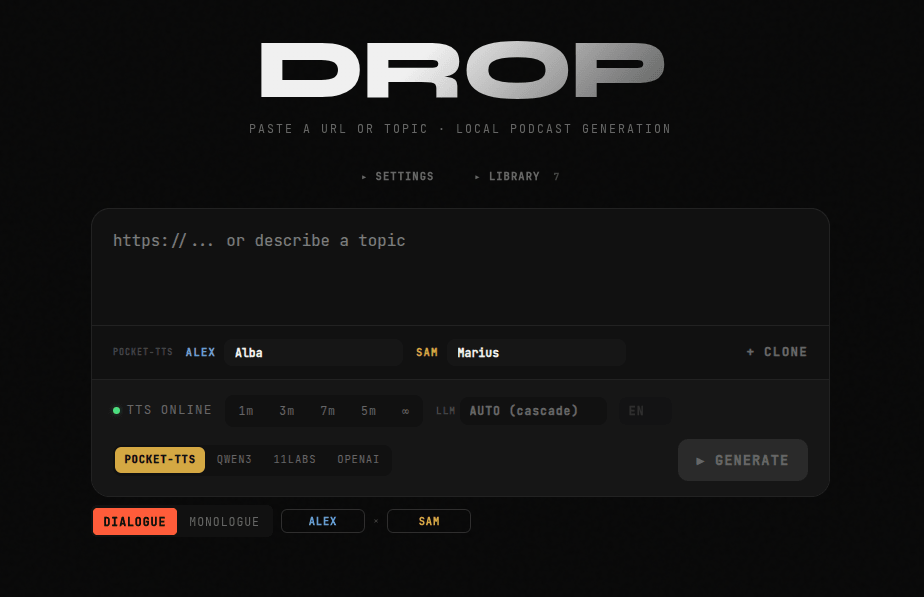
The hackathon version of Drop worked as long as three API providers had active credits. This rebuild makes both paths equally valid: drop an OpenRouter key in .env.local and be generating in sixty seconds, or run Ollama locally and never touch a cloud API.
What It Does
Script generation. Paste a URL or a topic. Drop scrapes the content with Readability, sends it to an LLM to write a script, then synthesizes each line with a TTS backend and stitches it into a single audio file. The whole pipeline streams — you watch each stage complete in real time.
Monologue and dialogue. Toggle between two-host conversation and single-speaker narration from the toolbar. The prompt system branches accordingly.
Generation lengths. Five options: 1, 5, 10, 30 minutes, or custom. Long episodes use a sliding-window approach, chaining multiple LLM calls so there's no artificial cap.
LLM cascade. Four backends: Ollama, OpenRouter, Featherless, Claude Haiku. Auto mode tries them in a configurable order and falls through to the next if one fails or isn't configured. A warning indicator flags misconfigured backends before you hit Generate.
Voice cloning. Upload a WAV or record from the microphone, and the local TTS backend clones that voice nearly instantly. Voice state persists between server restarts.
Library. Episodes auto-save after every generation. You can browse them, reload a previous generation, or re-voice a saved script with different voices without re-running the LLM.
Custom prompts. The full system and user prompts are editable in the UI with template variables. Revert to defaults with one button.
Encrypted settings profiles. Named profiles store API keys on disk, encrypted with AES-256-GCM. Multiple profiles for multiple key sets.
Technical Approach
Drop is two processes: a Next.js app for the UI, API routes, scraping, LLM calls, and audio stitching, and a Python FastAPI sidecar for text-to-speech. They communicate over a fixed HTTP contract (GET /tts/voices, POST /tts/generate, GET /health). The separation keeps the ML ecosystem in Python and the web ecosystem in Node. Docker Compose wires them together; a health check on the TTS container gates app startup.
The audio pipeline was new territory. Every TTS backend outputs different characteristics — pocket-tts returns 24kHz mono float32, ElevenLabs returns MP3 that has to be resampled via ffmpeg. The stitching layer normalizes before concatenating, or you get wrong-pitch playback and clicks at the seams.
A second local TTS option, Qwen3-TTS (nine named speakers, ten languages), lives in a separate sidecar with the same API contract. It's wired in but untested — my GPU isn't powerful enough to run it.
Sample output
A short podcast generated end-to-end with Drop. Same pipeline you'd run yourself: scrape, write, voice, stitch.
Full write-up on the blog — including the architecture decisions, the audio challenges, and what I'd build next.