Murmur
Open-source, self-hosted text-to-speech reader with five swappable TTS engines, voice cloning, and offline PWA support.
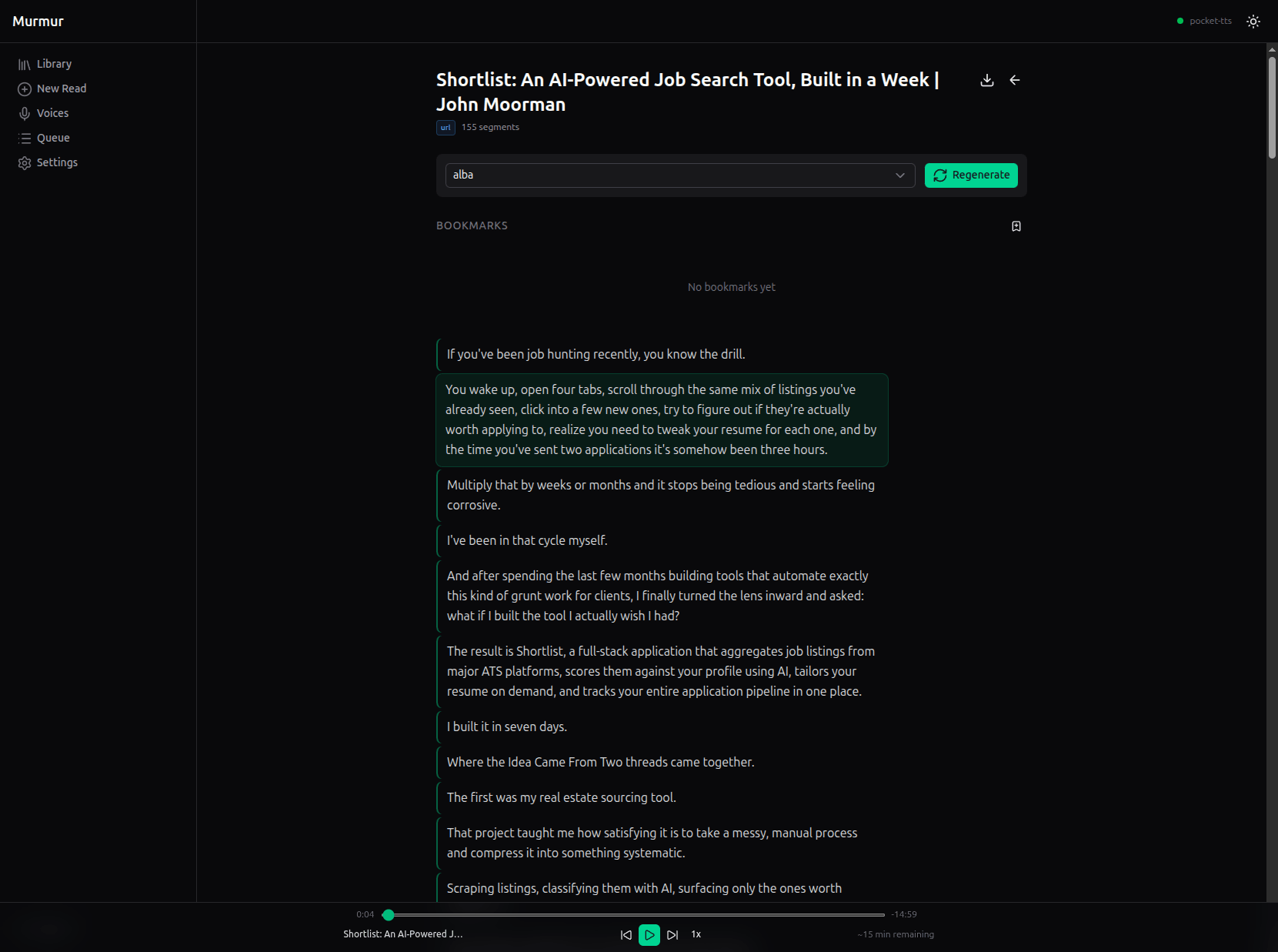
A self-hosted TTS reader born from a friend's request: "You're so close! Can you make something like this, but more directly for text-to-speech?" Murmur lets you paste text, upload documents (PDF, EPUB, DOCX), or feed it a URL, then listen with any of five swappable TTS engines. Everything runs locally. No API keys, no subscriptions.
What It Does
Five TTS engines. Pocket TTS ships as the default (CPU-friendly, eight built-in voices, 1.5 to 2.5x real-time generation). Four clone-capable engines are installable on-demand: CosyVoice 2, F5 TTS, XTTS v2, and GPT-SoVITS. Only one runs at a time to conserve resources.
Document intelligence. Extracts text and embedded images from PDFs, EPUBs, and DOCX files. URL imports use Mozilla Readability to pull article content. Images render inline in the reader.
Voice cloning. Upload a WAV file and any of the four clone-capable engines will synthesize new speech from it. Voices persist across sessions and transfer between engines.
Offline PWA. Installs on phones via Caddy's self-signed LAN HTTPS (no VPN or tunnel needed). Audio segments are cached locally via a service worker with background sync. Content is available offline once generated.
Multi-user support. JWT-based auth with httpOnly cookies. Each account's reads, voices, bookmarks, and settings are fully isolated.
Technical Approach
Murmur is three layers: a Nuxt 3 PWA as a thin frontend client, a Nitro BFF that validates JWTs and proxies requests, and a FastAPI orchestrator in Python that owns the SQLite database, manages engine lifecycles as subprocesses, and runs a FIFO job queue with SSE progress streaming. Generations survive browser crashes and laptop closings.
The hardest part was dockerizing all five engines into a single container. Each runs in its own virtual environment, installed on-demand. The Python ML ecosystem in containers produced nearly 20 distinct issues: torchcodec pulling CUDA dependencies into CPU-only builds, phantom packages yanked from PyPI, undocumented environment variables, and dependency cascades that revealed themselves one missing module at a time.
Hear the difference
Same source text, five engines, no editing. Pocket TTS is the CPU-friendly default; the other four are clone-capable and require a GPU to run quickly.
Full write-up on the blog — including the architecture evolution and the dockerizing ordeal.